15.6.22

The Coal Loop Day 1 - the Great Trunk Road

At the end of May 2022, one very fit man, one fit pensioner and one semi-fit pensioner set off to ride the Coal Loop from Hinton to Hinton via the Cardinal Divide, a total of 248 kms over 3 days.

the road to Smallboy Camp

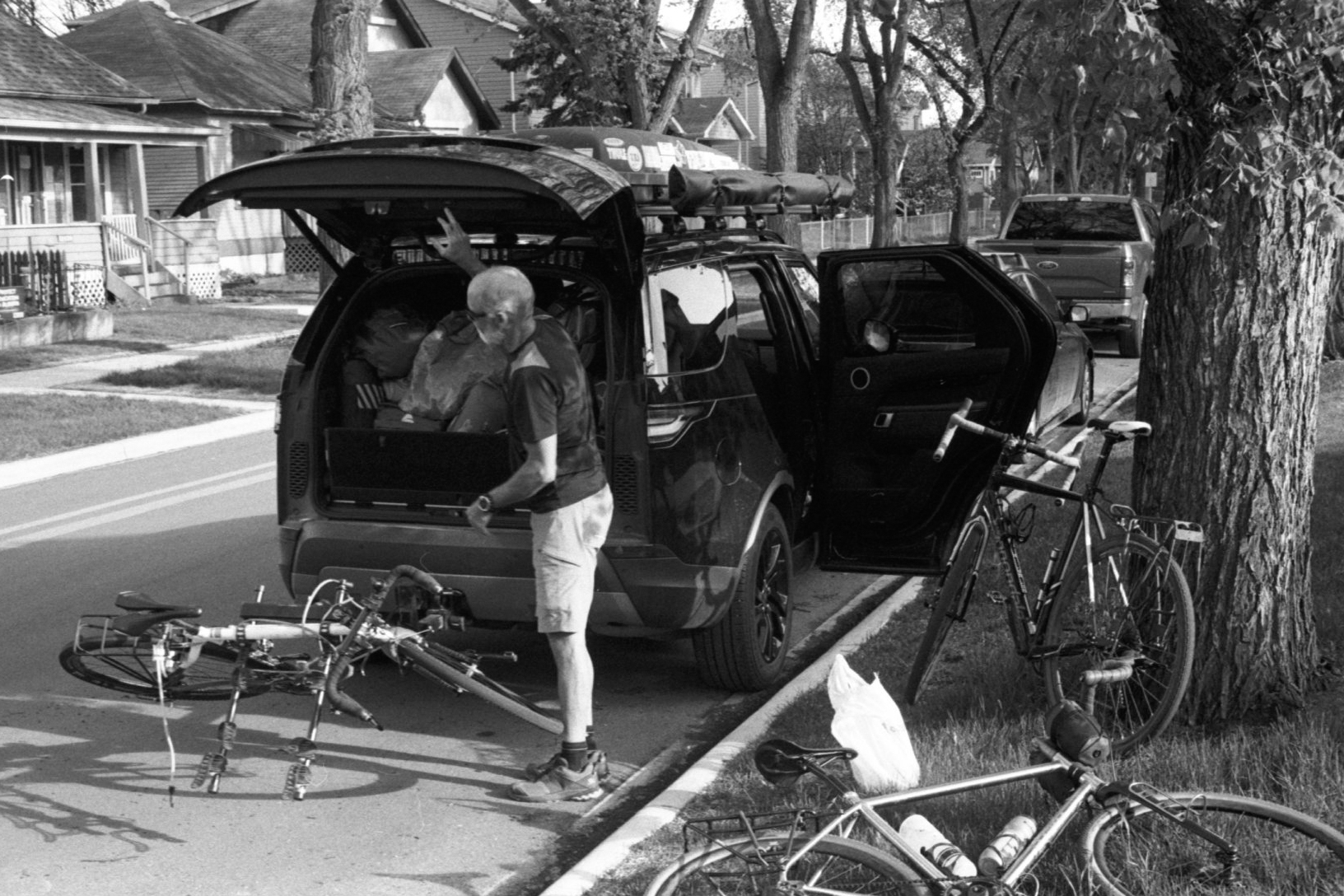
The load out for Hinton was bathed in Edmonton sunlight. The unload in Hinton was a dismal affair but the sun broke through on rollout.  

load out

rain soaked bike prep in Hinton

the only bear I saw was a big one

Departing Hinton at noon in broken sunshine, we quickly climbed out of town on Township Road 505A. Riding on a packed OTSO was a new experience.  Handling was noticeably slower but beginning a descent allows gravity to bring joy.  Uphill of course is a tedious endeavour.  The early rolling gravel was a good warmup for the scheduled 100 km day.  Unfortunately, Gary suffered a day ending calamity after a complete pedal fail at 25 kms.  He got a ride back to Hinton with a backhoe operator to buy new pedals. Mark and I continued, knowing that Gary would drive his vehicle to the campsite and ride back up the route to meet us. 
all vehicles displayed excellent road etiquette

Gary loads his bike bound for Hinton

Mark and I made our way further into logging country along some up and down roads.  All vehicles we met slowed down for us to reduce their dust trails, something I did not expect in rural Alberta. We crossed the Macleod River which flows into the Athabasca River at Whitecourt.  It was evident that the snow had not begun to melt; the rivers and creeks were very low.  
optimistic signage like this was ubiquitous en route

Mcleod River

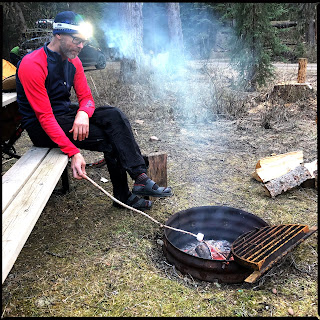
Gary met us about 8 kms from the Pembina Flats campsite and rode with us on new flat pedals.  It was good to get off the bike and eat hearty freeze dried bag food.  I broke out 4 marshmallows for dessert which made a fine end to the day.  Gary shared some firewater -- cinnamon flavoured whisky that was surprisingly tasty. 
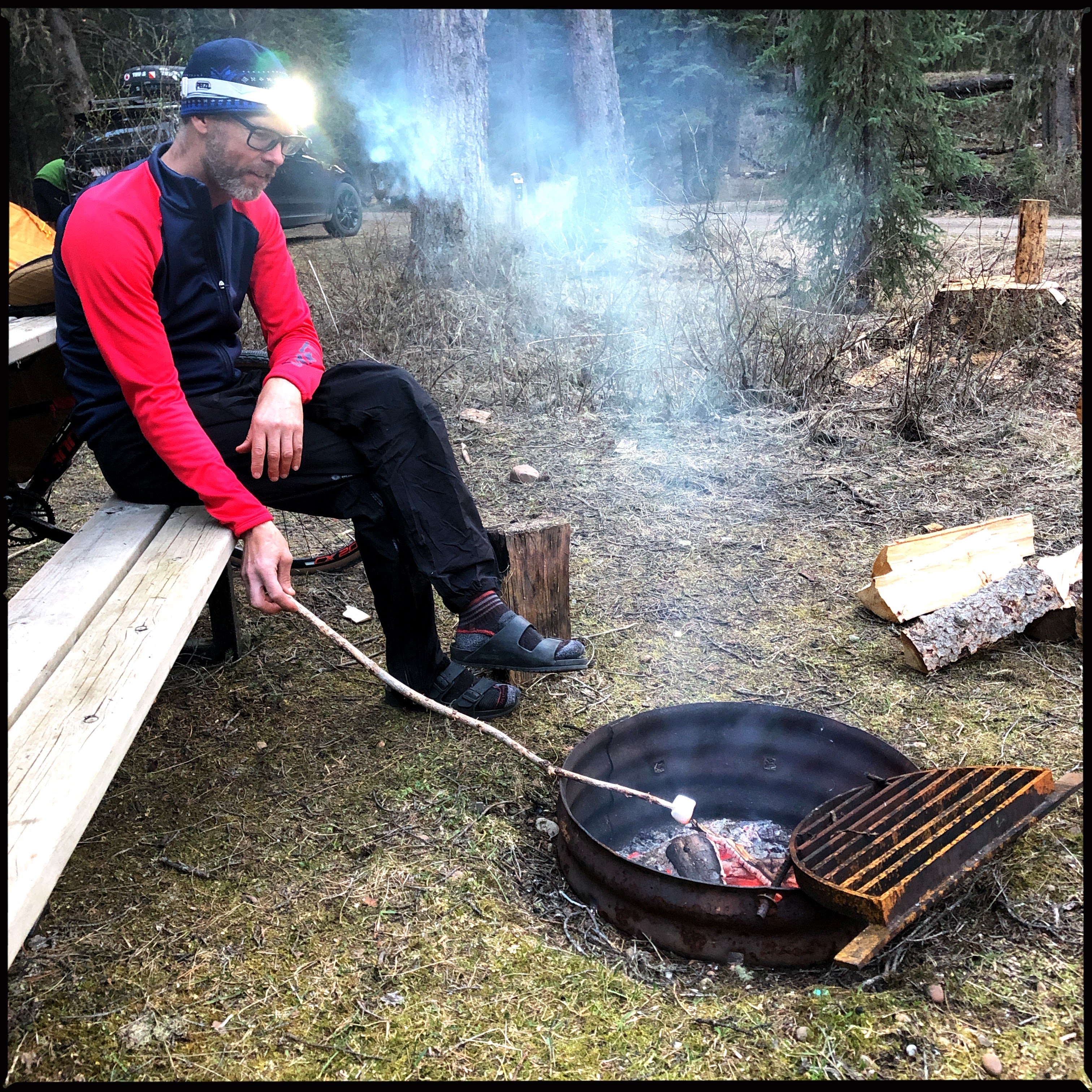
Mark wished for more marshmallows.  4 was all I could safely transport without creating MASHmallows.

We slept well and prepared ourselves for Day 2 - the assault on the Cardinal Divide. 


1.4.22

Announcing an actual WEBSITE

Abandoning all pretences of anonymity, Cycling Cosmonaut is proud to announce the opening of a WEBSITE of photographic work by Bob van Schaik, owner/operator of the Westmount Cosmodrome.


24.7.19

HL 88's Revolutionary Plywoodium Moto Helmet

HL88 Manufactory now offers a moto helmet made of PLYWOODIUM, the 88th element on the periodic table.  Known for its radioactive qualities, PLYWOODIUM resembles paper in its raw form. The special molding process means long wavy thick strands of PLYWOODIUM are pressed and shaped in proprietorial methods to the shape of your personal head (PHHT or Personal Head Helmet Technology).

The great innovation in using PLYWOODIUM for helmet manufacturing is its inherent radioactivity.  Up to now, radioactive substances were thought to have adverse health consequences for all life forms.  HL88 engineers have long argued against this theory and to show how safe PLYWOODIUM is, the new moto helmet comes with a 100% radioactive guarantee.


If you are still apprehensive, HL88 is offering a revolutionary face shield with each moto helmet.  The face shield will block extraneous radiation from entering your face hole while maintaining the healthy radiation inside your helmet. The "WIN WIN" face shield comes free with each moto helmet ordered while quantities last. 

7.2.19

Personal Drone Flight

You can do this.  Simply contact HL88 Manufactory for details.  Send a modest sum and receive personalized instructions to turn yourself into a drone.  

Act now to avoid disappointment.

26.8.18

The Newbrook Observatory

Replica of Sputnik 1 was the first satellite put up into space on October 7, 1957. Launched from the Baikinur COSMODROME, it was in orbit for 3 weeks.  It was a 23 inch diameter polished sphere.


from Wikipedia:
The Newbrook Observatory (a designated historic building) was built in Newbrook, Alberta, Canada by the Stellar Physics Division of the Dominion Observatory and operated as a space observatory from 1952 until 1957 [1] The observatory was equipped with a Super-Schmidt Meteor Camera, one of only six built by the Perkin-Elmer Company used to observe meteors. One of the observatory resident scientists, Art Griffen, was the first in North America to photograph the Sputnik 1 satellite (less than a week after its launch).

Tripod mount

  
House & outbuilding


12.8.18